
A Honda Prologue sitting in the driveway does not earn its keep. It just takes up space while the value under the hood or under the floor pan keeps drifting lower. Maybe the battery health dropped after a bad wreck. Maybe a software fault left it stuck in the garage. Maybe you simply moved on to another vehicle and never got around to dealing with the old one. Whatever the reason, a parked Prologue is a decision waiting to be made.
The good news is that selling a Honda Prologue in Florida does not require the car to run, look new, or come with a title in hand. This guide walks through what actually happens to a junk Prologue after it is sold, the myths that keep owners stuck, what to clear out before pickup, how to sell without a title, and how towing coverage works across the state.
What Buyers Actually Do With a Junk Honda Prologue
Most owners picture a junk buyer as someone who tosses the car straight into a crusher. That is rarely how it works. A vehicle buyer looks at three main paths before deciding what to do with a Prologue that no longer runs or is no longer wanted.
- Repair and resale: If the damage is limited and the battery pack still holds a reasonable charge, the car may be repaired and sold again as a used EV.
- Parts recovery: Electric vehicles carry valuable components. Motors, control modules, charging ports, seats, wiring harnesses, and body panels can all be pulled and resold individually.
- Battery and metal recycling: When the vehicle is too far gone to repair or part out, the battery pack is handled through certified EV recycling channels, and the remaining metal shell is processed for scrap.
This is exactly why running conditions should never stop you from selling. A Prologue with a dead battery pack, flood damage, or a totaled front end still holds recoverable value in its parts and materials.
Common Myths About Selling a Junk Honda Prologue
Owners often wait months or years longer than they need to because of a few myths that get repeated so often they start to sound true. Here is what actually holds up.
| Myth | Reality |
| The car has to run to be sold | A vehicle can be sold in almost any condition, including one that will not start or move |
| No title means no sale | There are legal ways to sell a Florida vehicle without the original title |
| EV batteries make the car impossible to sell | A damaged or degraded battery still has recoverable value and does not block a sale |
| You need to pay to have it towed away | Towing is typically arranged and covered as part of the pickup |
| Selling takes weeks of back and forth | The process can usually be handled in a single call and a scheduled pickup |
Believing any one of these myths is often the only thing standing between an owner and getting that space back in the driveway.
What Should You Remove From Your Car Before Pickup?
Before the tow truck arrives, take a few minutes to go through the Prologue. Anything left inside is treated as part of the vehicle once it changes hands, so it is worth a quick check rather than a surprise later.
| Item | Why It Matters |
| Personal belongings | Glove box, trunk, and door pockets often hold forgotten items, chargers, sunglasses, or paperwork |
| Charging cable and adapters | These are separate accessories and are easy to leave behind in a garage or trunk |
| License plate | Florida requires the plate to stay with the owner, not the vehicle, in most cases |
| Toll transponder | Remove it and deactivate it through your toll account to avoid charges from a new owner’s trips |
| Garage remotes or parking passes | Easy to overlook if they are clipped to a visor or stored in a console |
| Insurance and registration documents | Keep these for your records once the sale is complete |
A five minute walkthrough with the trunk, glove box, center console, and door pockets covers most of what gets left behind.
Documents Needed To Sell Without A Title
Losing a title is more common than most owners realize, and Florida has a defined path for handling it. The exact document needed depends on your situation.
| Situation | What Is Typically Needed |
| Title lost or misplaced | A duplicate title request through the Florida Department of Highway Safety and Motor Vehicles, or a bill of sale plus valid ID depending on the buyer’s process |
| Vehicle inherited | Proof of estate authority or an affidavit of heirship along with ID |
| Lienholder never released the title | A lien release letter from the lender or financial institution |
| Title held by a family member not present | A notarized power of attorney authorizing the sale |
| No title ever issued for an older or salvage vehicle | Prior registration paperwork and valid photo ID, reviewed on a case by case basis |
In every case, valid photo identification matching the seller’s name is the starting point. From there, the right supporting document usually clears the way to a completed sale.
How Statewide Florida Towing Coverage Works
One of the biggest hesitations owners have is assuming they will need to somehow get a non-running Prologue to a buyer themselves. That is not how it works with proper cash for cars service.
Towing coverage across Florida generally follows this pattern.
- Pickup is scheduled around the seller’s availability, not the other way around
- The tow truck comes to the vehicle’s location, whether that is a driveway, a business lot, or a storage yard
- Flatbed towing is used for non-running EVs to avoid stress on the drivetrain
- Towing is included as part of the offer, not billed separately
- Same day or next day pickup is often available depending on the area and schedule
You should never have to drive, push, or pay to move a car you are selling. If a buyer expects that from you, it is worth looking elsewhere.
Why Florida Honda Prologue Owners Decide To Sell
The Prologue is still a newer model on Florida roads, so most sellers are not dealing with old age. The reasons tend to be more specific to how EVs age and fail.
- Battery degradation after an accident: Even moderate collision damage near the battery pack can trigger a total loss from an insurer
- Flood exposure: Florida storms put low riding EV battery packs at real risk, and water intrusion is a common reason for a total loss decision
- Expensive out of warranty repairs: Once factory coverage ends, EV specific repairs can cost more than the vehicle is worth to fix
- Software or electrical faults: A vehicle that will not charge or power on is difficult to diagnose without dealer level tools
- Simply moving on: Some owners just upgrade or switch vehicles and want the old one gone without the hassle of a private sale
The Simple Process To Sell Your Honda Prologue
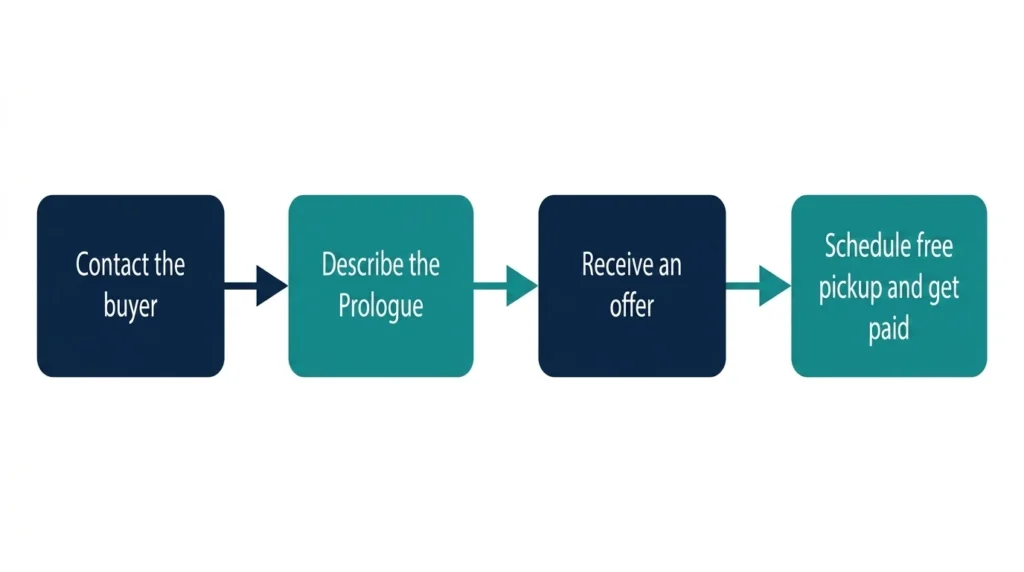
- Contact the buyer
- Describe the Prologue
- Receive an offer
- Schedule free pickup and get paid
Four steps cover the entire process from start to finish. There is no inspection appointment to sit through and no waiting on a private buyer to show up and change their mind.
FAQs
Do you buy a Honda Prologue that will not turn on at all?
Yes we do. A dead battery or a full electrical failure does not stop a sale.
Can I sell a Prologue that was in a flood?
Yes we do. Flood exposed EVs are handled through proper battery recycling and are a normal part of what we buy.
What if the battery pack is damaged but the rest of the car looks fine?
That is still a sellable vehicle. The condition of the battery is factored into the offer, not treated as a dealbreaker.
Do I need to bring the car anywhere for pickup?
No. Towing is scheduled to come directly to where the vehicle sits, and it is included as part of the process.
Is there a way to sell if the title was never transferred into my name?
Yes we do. Bring what documentation you have and we will walk through the right path for your specific situation.
How fast can pickup happen after I accept an offer?
Same day or next day pickup is available in most cases depending on scheduling.